Learn Japanese Through Anime Songs: A Fun Approach to Language Learning
Discover how anime songs can accelerate your Japanese learning. From pronunciation to vocabulary, singing along builds retention faster than traditional study methods.
Learning Japanese through anime songs works because music activates multiple brain regions simultaneously, creating stronger memory connections than textbook study alone. Singing along improves pronunciation, builds vocabulary naturally, and provides cultural context that makes grammar concepts stick. Start with slow opening themes, use romaji lyrics, and focus on understanding rather than perfection.
Experience this with real-time synced lyrics
Lyrical shows every word as it plays, in Korean, romanized, and in sync with the music.
Traditional Japanese study can feel like a slog. Hours of grammar drills, vocabulary lists, and textbook dialogues that sound nothing like real speech. But there's a more engaging path — one that millions of anime fans have discovered accidentally. Anime songs (called "anison" in Japanese) combine memorable melodies with repetitive, emotionally resonant lyrics that make language learning feel like entertainment rather than work.
Why Anime Songs Accelerate Language Learning
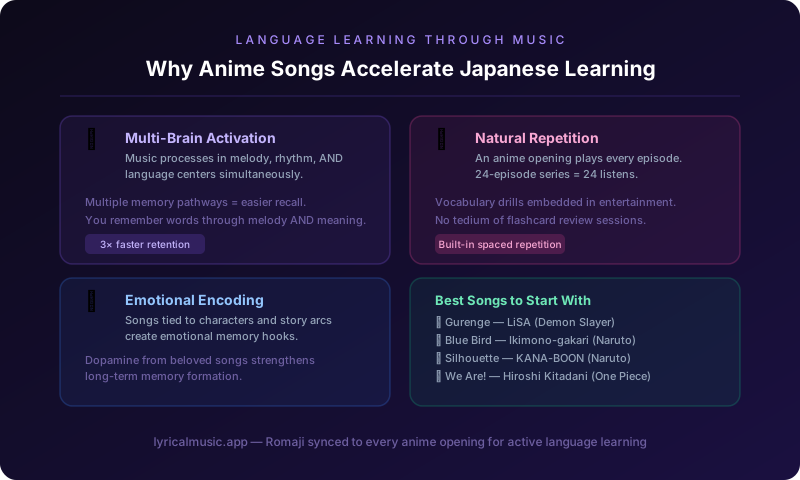
The science behind music-based language learning is solid. Understanding why it works helps you maximize the approach.
Music Activates Multiple Brain Regions
When you listen to music, your brain processes melody in one area, rhythm in another, and language in yet another. This distributed processing creates multiple memory pathways. Later, when you try to recall a word or phrase, you have several neural routes to access it — through the melody, the rhythm, or the meaning.
Repetition Without Boredom
Anime openings play at the beginning of every episode. If you watch a 24-episode series, you'll hear that song 24 times. This natural repetition drills vocabulary and grammar patterns into your memory without the tedium of flashcard review.
Emotional Connection Enhances Retention
The songs you love become tied to characters and story moments you care about. This emotional engagement triggers dopamine release, which strengthens memory formation. You're not just learning words — you're connecting them to feelings.
Natural Pronunciation Modeling
Professional anime singers (often called "anison artists") provide excellent pronunciation models. Their enunciation is clear, their pitch is consistent, and they represent how Japanese actually sounds in performance contexts. This beats textbook audio recordings that often sound robotic.
Getting Started: The Right Approach
Diving into complex songs immediately leads to frustration. Build your foundation properly.
Start with Slow, Clear Songs
Not all anime songs are beginner-friendly. Avoid rapid-fire rap sections and complex vocal runs initially. Look for:
- Ballad-style openings and endings
- Songs from slice-of-life anime (tend to have simpler vocabulary)
- Tracks with clear separation between syllables
- Themes from shows aimed at younger audiences (simpler language)
Use Romaji as Training Wheels
Romaji (romanization of Japanese) lets you read Japanese lyrics using familiar Latin letters. It's controversial among serious learners who say you should learn hiragana immediately, but for beginners, romaji removes a barrier to entry. You can focus on pronunciation and meaning without simultaneously struggling with a new writing system.
The compromise: Use romaji for your first month or two, then transition to reading hiragana and katakana as you learn them.
Focus on Chorus-First Learning
Anime songs follow predictable structures. The chorus repeats multiple times and usually contains the song's core vocabulary and themes. Learn the chorus thoroughly before attempting verses. This gives you immediate sing-along capability and builds confidence.
Understand Before Memorizing
Don't just parrot sounds mindlessly. Look up what the lyrics mean. Understanding creates context that makes memorization easier. You don't need deep grammatical analysis — just a general sense of what each section conveys.
Best Anime Songs for Beginner Japanese Learners
These songs were selected for clear pronunciation, moderate tempo, and vocabulary useful for everyday conversation.
Absolute Beginner Level
1. "Gurenge" by LiSA — Demon Slayer Opening
The song that broke into mainstream Japanese consciousness.
Hear this live in Lyrical: *"gurenge"*
Follow along in real time The verses build gradually, and the chorus explodes with energy. Vocabulary includes basic action words and emotional states that appear constantly in anime dialogue.
Key phrases to learn:
- "Kono yaiba de" (With this blade)
- "Shinobu" (Endure/hide)
- "Kokoro" (Heart)
2. "Unravel" by TK from Ling Tosite Sigure — Tokyo Ghoul Opening
Slower and more melancholic than most anime openings. The pronunciation is deliberate, giving you time to catch each syllable. The vocabulary focuses on identity and change — themes common in Japanese storytelling.
Key phrases to learn:
- "Kowareta" (Broken)
- "Boku" (I/me — casual male)
- "Sekai" (World)
3. "Silhouette" by KANA-BOON — Naruto Shippuden Opening 16
Upbeat and motivating without being vocally demanding. The "dattebayo" energy carries through even if you don't catch every word. The chorus repeats key phrases about moving forward and not giving up.
Key phrases to learn:
- "Mae ni" (Forward/ahead)
- "Susumu" (To advance)
- "Akiramenai" (Won't give up)
Beginner-Intermediate Level
4. "The Hero!!" by JAM Project — One Punch Man Opening
High energy but surprisingly repetitive. The "ONE PUNCH" sections give you easy participation moments. The vocabulary focuses on heroism and strength — words you'll encounter in countless shonen anime.
Key phrases to learn:
- "Hitori" (Alone/one person)
- "Tsuyoi" (Strong)
- "Tatakau" (To fight)
5. "Again" by YUI — Fullmetal Alchemist: Brotherhood Opening 1
A rock ballad with clear vocals and relatable themes of regret and moving forward. YUI's pronunciation is crisp, and the song structure is straightforward. The vocabulary includes time expressions and emotional states.
Key phrases to learn:
- "Mata" (Again)
- "Kako" (Past)
- "Mirai" (Future)
6. "Cruel Angel's Thesis" by Yoko Takahashi — Neon Genesis Evangelion Opening
The most iconic anime opening of all time. The tempo is brisk but the syllables are distinct. The poetic lyrics introduce more complex grammar patterns while remaining singable.
Key phrases to learn:
- "Zankoku na" (Cruel)
- "Tenshi" (Angel)
- "Teze" (Thesis)
Building Your Japanese Vocabulary Through Songs
Anime songs naturally introduce vocabulary across useful categories.
Emotional Vocabulary
Japanese culture places heavy emphasis on emotional nuance, and anime songs reflect this. You'll learn multiple words for love, sadness, hope, and determination — each with slightly different connotations.
Common emotional words in anime songs:
- Ai (愛) — Deep, romantic love
- Suki (好き) — Liking, affection
- Kanashii (悲しい) — Sad
- Sabishii (寂しい) — Lonely
- Ureshii (嬉しい) — Happy, glad
- Tsuyoi (強い) — Strong
Action and Movement Words
Shonen anime songs especially are filled with verbs describing movement and action. These translate directly to everyday conversation.
Common action words:
- Iku (行く) — To go
- Kuru (来る) — To come
- Miru (見る) — To see
- Tatakau (戦う) — To fight
- Hashiru (走る) — To run
- Tobu (飛ぶ) — To fly
Nature and Seasonal References
Japanese lyrics frequently reference nature and seasons — cultural concepts deeply embedded in the language. Spring (haru) represents new beginnings. Autumn (aki) evokes melancholy and change.
Common nature vocabulary:
- Hana (花) — Flower
- Tsuki (月) — Moon
- Hoshi (星) — Star
- Kaze (風) — Wind
- Ame (雨) — Rain
- Yoru (夜) — Night
Grammar Patterns You'll Absorb Naturally
Songs demonstrate grammar in context, making abstract rules concrete.
Particle Usage
Japanese particles (small words indicating grammatical function) appear constantly in songs. You'll hear "wa" marking topics, "ga" marking subjects, and "wo" marking objects so frequently that their usage starts feeling intuitive.
Example from songs:
- "Boku wa" (I [topic marker])
- "Kimi ga" (You [subject marker])
- "Yume wo" (Dream [object marker])
Verb Conjugations
Songs use various verb forms — present, past, negative, and desire forms. Hearing "tabetai" (want to eat) in a song makes the "-tai" desire form memorable in a way textbook examples rarely achieve.
Sentence Endings
Japanese sentences end with particles that indicate the speaker's attitude. "Yo" adds emphasis. "Ne" seeks agreement. "Na" expresses emotion. Songs use these constantly, teaching you natural speech patterns.
Practical Learning Techniques
Knowing what to study is different from knowing how to study. These techniques maximize your anime song learning.
The Shadowing Method
Shadowing means speaking or singing along with the track immediately after hearing each phrase — almost like an echo. This forces your mouth to produce Japanese sounds in real-time, improving pronunciation and fluency faster than silent study.
How to do it:
1. Play a short section (5-10 seconds)
2. Immediately repeat what you heard
3. Don't worry about perfection — focus on flow
4. Gradually increase the length of sections
Lyric Breakdown Sessions
Take one verse or chorus and dissect it completely. Look up every word you don't know. Identify the grammar patterns. Understand how the pieces fit together. This deep analysis complements the broader exposure of casual listening.
Session structure:
1. Listen to the section several times
2. Read romaji lyrics while listening
3. Look up unfamiliar vocabulary
4. Identify grammar structures
5. Practice singing with understanding
Spaced Repetition with Songs
Return to songs you've learned after increasing intervals — one day, three days, one week, two weeks. This spaced repetition cements long-term memory. The emotional connection to songs makes this review enjoyable rather than tedious.
Common Challenges and Solutions
Every learner hits obstacles. Here's how to handle the most common ones.
Challenge: Rapid Sections
Many anime songs include rap verses or rapid-fire vocal sections that seem impossible to follow.
Solution: Skip them initially. Focus on the slower chorus sections that repeat multiple times. As your ear develops, you'll start catching more of the rapid sections naturally. Speed comes with familiarity.
Challenge: Poetic vs. Practical Language
Anime songs use poetic, stylized language that differs from everyday speech. You won't hear "zankoku na tenshi no teze" in a Tokyo convenience store.
Solution: Treat song lyrics as poetry that expands your expressive range, not as conversational templates. Balance song learning with practical phrase study from other sources.
Challenge: Kanji Overload
Once you move beyond romaji, you'll encounter kanji (Chinese characters) that seem overwhelming.
Solution: Focus on hiragana and katakana first. These phonetic scripts appear in every song and give you solid pronunciation foundations. Kanji can come later as you build confidence.
Expanding Beyond Songs
Anime songs are a gateway, not a destination. Use them as a foundation for broader Japanese study.
Connect Songs to Shows
Understanding the story context enriches song meaning. "Gurenge" hits differently when you know Tanjiro's journey. The emotional investment in characters makes vocabulary more memorable.
Explore Related Artists
Love LiSA from Demon Slayer? She has an extensive discography beyond anime songs. Following artists across their work exposes you to different vocabulary and styles while maintaining familiar voices.
Join Fan Communities
Online communities discuss anime songs constantly. Reading these discussions in English introduces terminology and concepts. Eventually, you'll find Japanese fan discussions and start understanding those too.
Frequently Asked Questions
How long until I can understand anime without subtitles?
Singing along helps, but it's not sufficient alone. Most learners need 1-2 years of dedicated study (including songs, textbooks, and immersion) before understanding anime without subtitles. Songs accelerate the process but don't replace comprehensive study.
Should I learn hiragana before using anime songs?
Not necessarily. Romaji lets you start immediately. However, learning hiragana (takes about 1-2 weeks) opens up authentic lyric sources and improves your connection to the language. Consider it a parallel track rather than a prerequisite.
Can I become fluent just from anime songs?
No. Songs teach vocabulary, pronunciation, and cultural context, but they don't cover practical conversation, business Japanese, or formal speech patterns. Use songs as one component of a broader learning strategy.
What if I can't sing well?
Singing ability doesn't matter for language learning. The act of producing the sounds, feeling the rhythm, and connecting words to melody creates memory pathways. Sing privately if you're self-conscious — the learning benefits are the same.
Are there songs I should avoid as a beginner?
Extremely fast rap songs, complex vocal jazz arrangements, and songs with heavy dialect usage (like some Osaka-based characters) present unnecessary challenges early on. Save these for intermediate study.
Your First Week of Anime Song Learning
Here's a practical schedule to get started:
Day 1-2: Choose one beginner-friendly song. Listen passively 5-10 times while reading romaji lyrics. Focus on getting the melody and general feel.
Day 3-4: Learn the chorus using shadowing. Look up vocabulary for key phrases. Practice singing along with the music video.
Day 5-6: Attempt the first verse. Break it down line by line. Understand the grammar patterns even if you can't sing them smoothly yet.
Day 7: Review the entire song. Record yourself singing. Note areas for improvement but celebrate what you've learned.
The Cultural Bonus
Beyond language skills, anime songs connect you to Japanese culture in ways textbooks can't replicate. You'll understand why cherry blossoms (sakura) appear in so many lyrics. You'll feel the emotional weight of summer festival imagery. You'll recognize references to folklore and historical concepts that shape Japanese storytelling.
This cultural literacy makes you a more sophisticated language user. You don't just speak Japanese — you understand the world that produced the language.
Ready to sing and learn? Download Lyrical Sing "Gurenge" with full romanization in Lyrical.
*Related guides: Japanese Lyrics Romaji Guide • Anime Opening Lyrics Romanized • Easiest K-Pop Songs to Sing*