82MAJOR 'Like Fire': A Pronunciation-First Lyrics and Meaning Guide
Learn how to approach 82MAJOR's Like Fire with practical Korean pronunciation cues, a clear meaning guide, and a rehearsal method that keeps the song's attack intact.
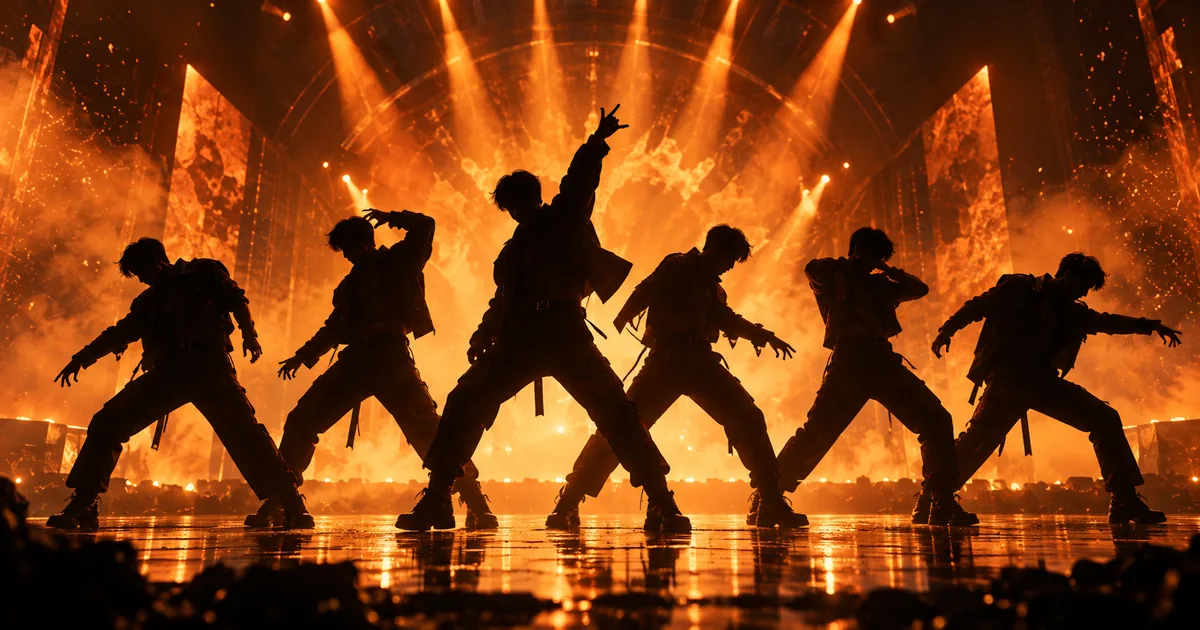
82MAJOR's "Like Fire" works best as a pronunciation exercise when you resist the urge to read every romanized syllable at equal speed. The September 2026 title track runs on clipped consonants, sharp entrances, and bursts of momentum. Learn the stress pattern first, then use romanization as a map instead of treating it as the performance.
Why "Like Fire" is a useful Korean practice track
"Like Fire" leads 82MAJOR's single album *HEAT*, released on September 1, 2026. The pairing of album and title track makes the concept easy to grasp: intensity, ignition, confidence, and forward motion.
For learners, the interesting part is not a single difficult word. It is the switch between forceful rap delivery and a hook meant to land instantly. A written line can look manageable and still feel impossible once the beat returns. That gap is normal. Your eyes are processing letters while your mouth is trying to copy timing, tone, and Korean sound changes all at once.
The fix is not to read faster. It is to reduce how much you are asking your brain to do in one pass.
If you are new to this process, start with what romanization actually does and the broader K-pop pronunciation guide.
Romanization is a rehearsal aid, not the lyric itself
Romanization turns Korean sounds into Latin letters. That makes a line approachable for listeners who cannot yet read Hangul, but it introduces compromises. English speakers may see "eo" and pronounce two separate vowels. They may give every final consonant a full release. They may stress a syllable because the spelling looks familiar in English.
Those habits can pull "Like Fire" away from its compact, percussive feel. The goal is to hear the Korean first and use the letters to remember what you heard.
Try this order:
1. Listen to one short phrase without reading.
2. Tap the main accents with your hand.
3. Read the Hangul if you can, or a checked romanization if you cannot.
4. Speak the phrase in rhythm without the instrumental.
5. Put it back over the track at reduced speed.
That sequence feels slower for five minutes and saves a lot of frustrated looping later. The guide to singing K-pop songs has more on breath and repetition.
The sounds English speakers tend to overwork
Korean pronunciation is not a matter of swapping each Hangul block for a fixed English sound. Neighboring syllables affect one another, and many consonants are less explosively released than their English counterparts.
Keep final consonants short
A syllable-ending consonant often closes quickly. Do not add an extra vowel to make it easier. If your version keeps growing little "uh" sounds between syllables, record yourself speaking the phrase and trim them.
Treat "eo" as one vowel target
Common romanization uses "eo" for ㅓ. It is not the English sequence in "theory." Hear it as one sound and copy the singer rather than solving it from the letters.
Watch the difference between plain, tense, and aspirated attacks
Korean distinguishes consonants that romanization can make deceptively similar. On a hard-driving track, those attacks shape the groove. Exaggerating aspiration everywhere makes the line breathy. Flattening everything makes it dull. Short A/B loops are more helpful than a paragraph of phonetic terminology.
Let linked speech stay linked
Words on a lyric page have spaces. Sung phrases do not always feel separated that way. Listen for where one syllable flows into the next, then mark your rehearsal line with slashes based on audible phrase groups rather than grammar alone.
For a gentler starting point before returning to 82MAJOR, try these K-pop songs for beginners.
What the "Like Fire" concept is saying
The central fire image is direct. Heat suggests energy that spreads, pressure that changes a situation, and confidence that cannot sit still. In a performance track, that metaphor also describes the group itself: the members arrive to raise the temperature rather than observe from the edge.
What keeps the concept from feeling purely decorative is the delivery. The words and arrangement keep pushing toward action. Fire is not presented as warmth by a fireplace. It is motion, risk, and visibility.
That makes tone important in translation. A flat English gloss may preserve the dictionary meaning while losing the challenge inside it. When you annotate a line, add a second note for attitude: taunt, command, boast, invitation, or release. That small label helps you sing a meaning instead of reciting a translation.
How to learn the hook without fighting the tempo
The hook is where most listeners want to begin, and that is sensible. It repeats, carries the title phrase, and provides an easy checkpoint. The mistake is trying to perform the whole section on the first loop.
Break it by breath, not by line breaks. Find the first place the vocalist naturally resets. Practice only the material before that point. Once it feels boring, add the next unit.
Then remove the track and keep only a metronome or finger tap. If the syllables fall apart without the recording, you were following rather than producing the rhythm yourself. Rebuild it slowly.
Finally, return to the original and listen more quietly than your own voice. This exposes unclear consonants immediately. Singing over loud playback can create the illusion that you nailed a phrase because the artist covered every gap.
The approach also works for denser tracks in the ATEEZ romanized lyrics guide and NCT lyrics guide.
A seven-pass practice session
Use one section, not the full song.
Pass one: listen with your eyes closed and tap the accents.
Pass two: read the meaning, then describe the attitude in one plain word.
Pass three: speak only the stressed syllables in time.
Pass four: add the quieter syllables between them.
Pass five: record at reduced speed and compare only the entrances.
Pass six: repeat at normal speed with the instrumental low.
Pass seven: perform once without stopping, even if one word slips.
The last pass matters. Constantly restarting teaches you to panic at mistakes. Finishing teaches recovery, which is part of singing any fast song.
Build a personal pronunciation sheet
Do not copy the entire lyric into another document. Make a compact rehearsal sheet containing only the fragments that trip you up. For each one, add a slash where you breathe, underline the syllable that lands on the beat, and write one plain-English note about the sound you keep missing.
A useful note might say "close the final consonant" or "one vowel, not two." It should not become a miniature linguistics lecture. If you need six lines of explanation beside every phrase, the sheet will slow you down when the track is playing.
Record the same difficult fragment at the beginning and end of a session. Compare the timing first, then the vowels, then the consonants. Listening for everything at once makes improvement hard to hear. A narrow comparison usually reveals that one problem is already fixed and another needs tomorrow's attention.
This method also prevents romanization from becoming a crutch. As the sound settles into memory, delete the extra note. Eventually the page should get simpler, not more crowded. The goal is to look up less and listen more. If you want another focused practice track afterward, the Kihyun "So Good" guide offers a useful contrast in phrasing and vocal texture.
What I would not do with this track
I would not start by copying a fan-posted romanization with no Hangul beside it. Tiny spelling choices can send pronunciation in the wrong direction. I would not paste a full copyrighted lyric sheet into notes when official or licensed synchronized lyrics are available. And I would not judge progress by whether I can keep up while whispering. Quiet mumbling hides weak consonants.
Use a lyric display as the prompt, then do the work with your ears. Lyrical's real-time lyrics guide explains how synchronized lines reduce the stop-search-return loop on iPhone. You can also compare the workflow with Apple Music romanization and Spotify lyric troubleshooting.
FAQ
Who sings "Like Fire"?
"Like Fire" is performed by the South Korean boy group 82MAJOR.
When was "Like Fire" released?
It was released on September 1, 2026 as the title track of the single album *HEAT*.
What does "Like Fire" mean?
The song uses fire and heat as images for force, confidence, momentum, and an energy that spreads once it begins.
Is romanization enough to pronounce the song correctly?
No. Romanization is helpful scaffolding, but it cannot fully represent Korean consonant distinctions, linked speech, or the vocalist's timing. Listen first and use the spelling as a reminder.
What is the hardest part for beginners?
The main challenge is coordinating pronunciation with the fast rhythmic delivery. Short phrase loops work better than repeatedly attempting the entire verse.
Should I learn Hangul before singing "Like Fire"?
You do not need to postpone the song until you know Hangul, but learning the alphabet will reduce ambiguity. Even basic character recognition helps you avoid English spelling habits.
How can Lyrical help me practice?
Lyrical keeps lyrics synchronized with the music so you can hear, check, and repeat without leaving the listening moment. Explore the Lyrical app for the current iPhone workflow.