Learn Korean with K-Pop: A Beginner's Guide
Can you learn Korean through K-pop? Here's how to use your favorite songs to pick up vocabulary, pronunciation, and grammar basics while singing along to BTS, Blackpink, and more.
Learn Korean with K-Pop: A Beginner's Guide
You can learn basic Korean through K-pop by using songs to build vocabulary, practice pronunciation, and get familiar with sentence structures. While K-pop alone will not make you fluent, it is an excellent supplement to formal language study. Focus on common words, repetitive hooks, and simple ballads to maximize learning.
Experience this with real-time synced lyrics
Lyrical shows every word as it plays, in Korean, romanized, and in sync with the music.
That is the short answer. But if you have ever sung "saranghae" without knowing what it means, or wondered why Korean sentence structure feels backwards, you need a strategy for turning your music obsession into actual language skills.
This guide shows you how to learn Korean through K-pop effectively — what works, what does not, and how to combine songs with proper study.
What Most People Get Wrong About Learning Korean Through K-Pop
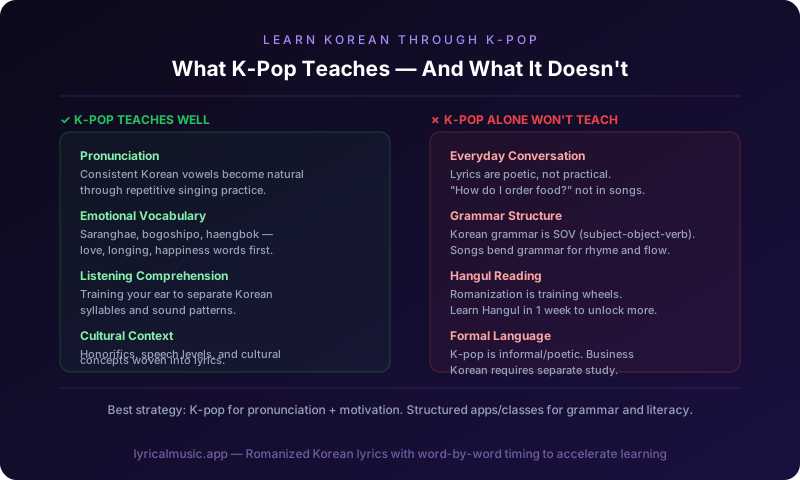
The biggest mistake is thinking K-pop alone will make you fluent. It will not. K-pop lyrics are poetic, stylized, and often grammatically loose. You will learn "saranghae" (I love you) before you learn how to order food. You will master emotional expressions but struggle with basic conversation.
Another mistake is ignoring Hangul, the Korean alphabet. Romanization helps you sing along, but it is training wheels. Real Korean literacy requires learning Hangul. The good news: Hangul is scientifically designed to be easy. You can learn it in a few days.
The third mistake is passive listening. Playing K-pop in the background does not teach you Korean. Active engagement — looking up words, studying lyrics, singing along consciously — is what creates learning.
The Counterintuitive Truth About K-Pop Korean
Here is what surprises people: K-pop uses a relatively small vocabulary. The same words appear across hundreds of songs. Learn 100 common K-pop words, and you will recognize them everywhere.
The most common words in K-pop:
- Sarang (love)
- Hana (one/together)
- Jebal (please)
- Gomawo (thank you)
- Annyeong (hello/goodbye)
- Yeppeo (pretty)
- Jinjja (really)
- Ne (yes)
- Ani (no)
- Na (I/me)
These words appear in BTS, Blackpink, Twice, and every other group. You probably know some already without realizing it.
The emotional journey of learning Korean through K-pop: confusion at first when everything sounds foreign. Then recognition when you catch a familiar word. Then excitement when you understand a whole phrase. Then motivation to learn more formally.
Step-by-Step: Learning Korean Through Songs
Step 1: Learn Hangul first
Before diving into lyrics, spend 3-7 days learning the Korean alphabet. Use free resources like Talk To Me In Korean or How to Study Korean. Hangul is logical and consistent. Once you know it, you can read any Korean word, even if you do not know the meaning.
Step 2: Pick simple songs
Start with ballads and slower songs. Fast rap verses are too complex for beginners. Try:
- "Spring Day" by BTS — clear vocals, emotional, moderate vocabulary
- "Stay" by Blackpink — simple structure, repetitive hooks
Hear this live in Lyrical: *"Spring Day"*
- "Feel Special" by Twice — encouraging message, clear pronunciation
Step 3: Study lyrics, not just listen
Use an app like Lyrical that shows both Hangul and romanization. Read along as you listen. Notice which sounds match which letters.
Step 4: Look up common words
Pick 5-10 words per song to learn. Write them down. Use them in sentences. "Sarang" becomes "I learned sarang means love."
Step 5: Sing along consciously
Do not just mouth the words. Pronounce them carefully. Feel how your mouth makes Korean sounds. This builds muscle memory.
Step 6: Gradually increase difficulty
Move from ballads to mid-tempo songs to faster tracks. Add rap verses last. Your brain adapts to faster speech over time.
What K-Pop Teaches Well (And What It Does Not)
K-pop teaches well:
- Pronunciation — You hear native speakers constantly
- Vocabulary — Emotional words, relationship terms, everyday expressions
- Rhythm and intonation — How Korean naturally flows
- Cultural context — Formality levels, social relationships
- Motivation — Music makes learning enjoyable
K-pop does not teach well:
- Grammar — Lyrics often break rules for artistic effect
- Formal speech — K-pop uses casual language, not business Korean
- Complex sentences — Lyrics favor short, punchy phrases
- Reading and writing — You need separate study for literacy
- Everyday conversation — Ordering food, asking directions, small talk
Common K-Pop Words to Learn First
Emotions:
- Sarang (love)
- Seulpeum (sadness)
- Gippeum (joy)
- Duryeoum (fear)
- Hwaga (anger)
Relationships:
- Chingu (friend)
- Oppa (older brother/boyfriend)
- Unnie (older sister/girlfriend)
- Hyung (older brother — male speaker)
- Noona (older sister — male speaker)
Time and place:
- Oneul (today)
- Naeil (tomorrow)
- Eoje (yesterday)
- Jigeum (now)
- Yeogi (here)
Actions:
- Gada (to go)
- Oda (to come)
- Meokda (to eat)
- Majhda (to meet)
- Jada (to sleep)
Descriptions:
- Yeppeuda (pretty)
- Meosjida (cool)
- Jota (good)
- Nappa (bad)
- Jinhada (true/real)
Learn these 25 words, and you will recognize them constantly across K-pop songs.
Using Lyrical to Learn Korean
Lyrical supports language learning better than standard lyrics apps:
Hangul and romanization: See both writing systems simultaneously. Gradually transition from reading romanization to reading Hangul.
Word-by-word highlighting: Each word lights up as sung. You connect sounds to meanings in real-time.
Repeat and practice: Use the app to replay sections. Practice pronunciation until it feels natural.
Build vocabulary: Notice repeated words across songs. "Sarang" appears in hundreds of tracks. Each repetition reinforces learning.
The specific thing Lyrical does: it makes Korean visible while you enjoy music. Passive exposure becomes active learning.
Combining K-Pop With Formal Study
K-pop works best as a supplement, not a replacement for structured learning:
Use K-pop for:
- Daily listening practice
- Pronunciation models
- Vocabulary reinforcement
- Cultural understanding
- Motivation and enjoyment
Use formal resources for:
- Grammar rules
- Reading and writing Hangul
- Speaking practice
- Conversation skills
- Comprehensive curriculum
Recommended resources:
- Talk To Me In Korean (free lessons)
- How to Study Korean (comprehensive grammar)
- HelloTalk (language exchange app)
- Italki (online tutors)
- Korean dramas (for listening practice)
Common Questions About Learning Korean Through K-Pop
Can I become fluent just by listening to K-pop?
No. Fluency requires speaking practice, grammar study, reading, writing, and comprehensive exposure. K-pop helps with listening and vocabulary but cannot provide complete language education.
How long until I understand K-pop lyrics?
Basic words appear immediately. Simple phrases take a few months. Complex lyrics require 1-2 years of study. Full fluency takes years of dedicated effort.
Should I learn Hangul or use romanization?
Learn Hangul. It takes a few days and unlocks real Korean literacy. Romanization is temporary training wheels.
Which K-pop songs are best for learning?
Ballads with clear vocals and simple vocabulary. "Spring Day" by BTS, "Stay" by Blackpink, "Through the Night" by IU. Avoid fast rap initially.
Will learning Korean ruin my enjoyment of K-pop?
Opposite — it deepens enjoyment. Understanding lyrics adds layers of meaning. You appreciate wordplay, cultural references, and emotional nuance.
How many words can I learn from K-pop?
Hundreds of common words. But K-pop vocabulary is limited and repetitive. You need formal study for broader language ability.
Is K-pop Korean different from real Korean?
Somewhat. K-pop uses stylized, poetic language. Real conversation is simpler in some ways, more complex in others. K-pop prepares you for real Korean but does not fully substitute.
Can I use K-pop to prepare for TOPIK (Korean proficiency test)?
K-pop helps with listening sections and vocabulary. But TOPIK requires formal grammar, reading comprehension, and writing skills that K-pop alone cannot provide.
The Bottom Line
K-pop is a powerful supplement for learning Korean. It teaches pronunciation, builds vocabulary, and keeps you motivated. But it is not a complete language course. Combine K-pop with formal study, learn Hangul, practice speaking, and use resources designed for language learning.
The journey from singing "saranghae" without understanding to reading Korean tweets and understanding variety shows? K-pop starts that journey. Formal study completes it.
Try Lyrical Free
Lyrical shows real-time synced lyrics with both Hangul and romanization. Perfect for learning Korean while enjoying your favorite K-pop songs.
Download Lyrical Experience K-pop lyrics synced to the music.
*Last updated: March 2026*